The Weird Charm of Rural Hokkaido Gas Stations
 staff
staffFirst, Let Us Talk About the Attendant
Filling up the tank is supposed to be an errand. Something you do because you have to, somewhere between point A and point B. But if you have driven through rural Hokkaido, you already know the truth: some of the best moments of a road trip happen at gas stations. Not despite the fact that they are gas stations, but because of what they become out here in the countryside, where the nearest town might be 40 kilometers behind you and the next one is somewhere over the mountains.
After years of driving these roads for Land-N-Cruise, we have come to appreciate the rural Hokkaido gas station as something close to an institution. Part rest stop, part community center, part time capsule. Here is why you might feel the same way.
Japan still has a surprising number of full-service gas stations, and Hokkaido has more than most. In Tokyo or Osaka, self-service pumps dominate. Out here, you pull in and someone walks up to your window. Usually it is an older gentleman in a crisp uniform, sometimes with a towel draped over one shoulder. He will ask you what fuel you need -- for most rental cars, the answer is "regyuraa mantan de" (fill it up with regular) -- and then things start happening that you did not expect.
He fills the tank. Then he cleans your windshield. Then he might crouch down and take a look at your tires. If it is winter or early spring, he will mention the road conditions ahead. If you look even slightly confused about where you are going, he will pull out a well-worn paper map and point you in the right direction.
When you are done, he will bow, say "arigatou gozaimasu, ki wo tsukete" (thank you, please drive safely), and wave you out of the lot. The whole exchange takes five minutes, but it leaves an impression. In a country already famous for good service, the rural Hokkaido gas station attendant operates on another level entirely. Compare this with a self-service pump in central Sapporo where you swipe your card and never speak to a human being. The contrast is enormous.
The Mystery Zone Next to the Pumps
The best rural Hokkaido gas stations have a section that defies easy description. It is not a convenience store. It is not a farm stand. It is something in between, and it changes with the seasons.
In summer and early autumn, you will find crates of fresh corn (called tou-kimi in Hokkaido dialect, not toumorokoshi like the rest of Japan), bags of potatoes pulled from a nearby field, and sometimes melons that cost a fraction of what they would in a Sapporo department store. The prices are written on hand-drawn signs with thick markers, and reading them requires a working knowledge of handwritten Japanese numbers. Good luck.
There is often a small indoor area with a couple of folding chairs, a table with some magazines from three months ago, and a television tuned to NHK (Japan's public broadcaster) showing agricultural news or weather forecasts. Nobody sits there for long, but everybody seems to glance at the screen while paying for gas. It is oddly comforting, like the waiting room of a friendly doctor.
Operating hours are another adventure. Some stations post hours that say 8:00 to 18:00, but the attendant might lock up at 17:30 if business is slow. Others seem to operate on a schedule known only to the owner. On weekends, your guess is as good as ours.
If you are driving in rural Hokkaido, the safe strategy is to never let your tank drop below half, because the station you were counting on might be closed when you arrive. Google Maps shows real-time open and closed status for most Japanese gas stations, so check before you commit to a detour. For a deeper look at fuel planning for spring road trips, check out our spring driving guide.
Filling Up as a Way to Mark the Journey
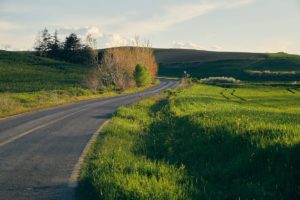
There is something about the act of stopping for gas that gives shape to a road trip. Hokkaido is vast. The distances between landmarks are longer than anything most visitors are used to in Japan. You can drive for an hour and see nothing but farmland, mountains, and sky. In that context, pulling into a gas station becomes a kind of punctuation mark in the story of your day.
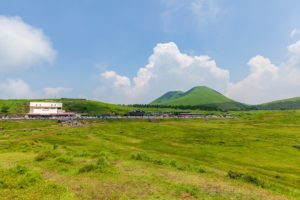
You step out of the car. You stretch. You look around and notice the mountains in the distance, the color of the sky, the way the air smells different here than it did at the last stop. While the tank fills, you have a moment to think about where you have been and where you are going next. It is not meditation exactly, but it is the closest thing you will get to it while holding a fuel nozzle.
Paying for gas in rural Hokkaido is its own small experience. Expect to pay around 170 to 180 yen per liter for regular gasoline. Cash is still king at many stations. Some accept credit cards, but do not count on it at the smaller operations. The receipt might be handwritten. The change is counted out carefully and placed in your palm. There is a rhythm to these interactions that feels slower and more deliberate than anything in the cities. For more driving Hokkaido tips on fuel types and payment, see our complete gas station guide for tourists.
As you pull out of the station and back onto the road, there is that moment of satisfaction that comes with a full tank. Everything feels possible again. The next mountain pass, the next coastal stretch, the next hidden onsen (hot spring) town you read about somewhere -- it is all within reach. That "yoshi, ikuzo" feeling (roughly translated: alright, let us go) is one of the best parts of driving in Hokkaido, and it always starts at a rural Japan gas station.
If you are planning a route through some of Hokkaido's most scenic rural areas, our guide to spring road trips after the snow melts covers the best drives and what to expect along the way.
Why Rural Hokkaido Gas Stations Are Worth Stopping For
Next time you are driving through Hokkaido and the fuel gauge dips toward the middle, do not think of it as a chore. Think of it as a chance to meet someone who genuinely cares that you drive safely. A chance to buy corn that was in the ground yesterday. A chance to stand outside for two minutes and look at mountains that have been there for millions of years, while a man in a uniform waves you back onto a road that stretches further than you can see.
These are the moments that turn a rental car trip into a real Hokkaido experience. And they do not cost anything beyond the price of a tank of gas. When you are ready to explore the roads less traveled, Land-N-Cruise can set you up with the right car and the local knowledge to find these places. The pumps are waiting.